


You may have seen this video floating around social media about rats in pants.
@dexter.mp4 The sècks lives of rats in pants! #ignobelnovember #learneclecticthings #learnontiktok #science #greenscreen
The video profiles the work of Dr. A Shafik from the 90s and suggests that polyester undies may be a viable method of contraception.
But is this really possible?
Did he really put rats in pants?
Yes, he most definitely did. Not only did he put rats in pants, but he also put dogs in pants, and then later, men. Human men. Though, presumably they put on their own pants.
And oh boy, did he put pants on a lot of rats! He dressed 60 rats in total. Fifteen rats wore cotton, 15 wore wool, 15 wore polyester and another 15 wore a polyester-cotton blend – for a whole year! An additional 15 rats took part in this experiment but wore no pants (to serve as a control group).
I wonder if the no-pants rats started to feel shame over their naked bodies after a while.
I guess we’ll never know.
Why did he put pants on rats?
He wanted to find out if polyester impacted sexual functioning. Why was this something he was thinking about? Hard to know for sure. Maybe he was trying to solve an infertility problem for someone. Maybe he just had a vendetta against polyester pants.
He died in 2007 and there doesn’t seem to be any info on why he was so motivated to study this. He self-funded the research that he did, which allowed him to study what he wanted for the sake of furthering scientific knowledge. A bit of a rebel, this one.
What were the findings?
When he studied rats, he was measuring their intromission to the mounting ratio (how often they were generally humping vs how often they were actually sticking it in). It turns out that they weren’t getting it in as much as the rats without pants.
To be honest, I think that’s a pretty generalizable result. Fucking with pants on is way harder than fucking without pants. He really needed a more in-depth study to really take it a step further.
So then, he jacked off some dogs.
Wait, what’s that last bit about the dogs?
So, after he dressed up the rats and perved on them, judgingly, he thought he’d repeat the process with dogs.
This time, he measured their sperm counts, motility, and sperm morphology. He also checked to make sure their balls remained the same size and “consistency”.
The dogs were “digitally massaged” and then given a fake vagina to fuck in order to obtain the semen specimens. Ethically, I can’t support this research. But they already did it, and they have results.
It turns out that the dogs wearing cotton undies were totally unchanged. However, the dogs wearing polyester undies significantly reduced their sperm counts and motility. Their morphology was messed up, too.
Interestingly, their serum hormonal levels remained unaffected. Shafik also studied female dogs, or as he prefers to call them: pregnant bitches.

- because “they ain’t shit”, or something like that
What did he find out about pregnant bitches?
Never before had I read such gratuitous use of the term pregnant bitches in a scientific paper.
He did say female dogs once, but generally, they were “pregnant bitches”. He gave these pregnant bitches some crotchless panties (so they wouldn’t interfere with peeing or pooping) and saw how it affected their pregnancies.
Most of them were fine and normal, even the ones wearing polyester/cotton blends. In the 100% polyester group, however, 2 of the 7 dogs spontaneously aborted their pregnancies. In these two, their hormones had been affected.
Could polyester underwear cause abortions? Possibly. Don’t tell the Republicans.
What’s the theory?
It is already established in the scientific literature that the temperature of the nether regions can affect fertility. This is why doctors recommend to their male patients who are trying to make a baby to wear loose-fitting underwear.
What hadn’t even been investigated, was the effect of different fabrics. These studies measured temperatures and even went so far as to ensure loose fitting garments so as not to confound the variables.
Dr. Shafik theorized that the electrostatic potential generated on the testes could disrupt the functioning of sperm. He studied this with a group of men wearing polyester underwear for one hour and even made a fun little diagram so he could have an excuse to draw some balls.
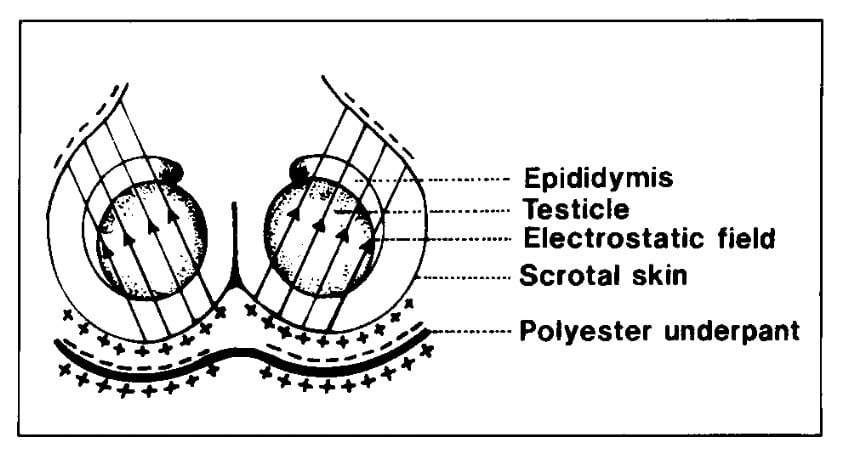
Does wearing polyester affect human fertility?
It seems to. Dr. Shafik ended up doing a study in adult men where they wore polyester sack slings for a year and by the end of that year, all of the men were azoospermic, meaning they had no sperm in their ejaculate. Or as the TikToker said, “no swimmers in their soup”.
It generally took about 5 months for this to happen. After a year, they removed the slings and less than 6 months later, they were back to pre-test levels. They were studying men who were coupled, and all 5 couples who intended to conceive after the study, did.
During the study, the female partners used “contraceptives” until their partners were azoospermic. No one got pregnant during the time the slings were on and working.
Are the effects reversible?
In all of these studies, the effects were generally reversible, though a couple of the dogs didn’t return to normal at the time of follow-up, so there’s a chance that a small portion will remain infertile for longer.
But generally, it seems pretty ok.
How does it compare to the pill?
Well, this is a big topic, but ultimately there have been known side effects to being on the pill and new effects are still being uncovered. Depending on which formulation you’re on, you might actually be pumping your body full of androgens, so-called “male hormones”. This has led to excess hair growth, sweatiness, and acne.
Recent research has actually found that there are potentially neurological effects as well. Women on the pill shared certain distinctive brain patterns associated with men. This impacted their spatial awareness, facial recognition, and verbal fluency.
It is also well known now that the pill has a strong connection with anxiety and depression. In a large study within teenagers, ones who were on the pill were 80% more likely to develop depression. There is a lot more to investigate here, but it’s clear that hormonal contraception has far-reaching consequences.
Isn’t polyester super unsustainable?
Yes. Polyester is generally made from oil, which isn’t renewable, but polyesters are beginning to be made from corn and other crops, which technically are. Some polyesters can be recycled, and some polyesters are made from recycled plastic bottles, but there are limits to this process.
Polyester fabrics also often contain BPAs and PFAs (also known as forever chemicals). Not only can these substances impact your hormones, but they have also been linked to cancer, liver disease, and birth defects.
Hell, I even wrote a whole review list on PFAs-free period underwear. So this issue truly affects everyone.

It’s possible to make polyester without these substances, but it’s not easy to find.
Even if you’re just using 100% BPA and PFA-free polyester, the real trouble is that it’s still basically plastic. Every time you wash polyester clothes, microplastics are then released and sent into our water systems. From there, they can do all sorts of damage to our bodies and the environment.
So, how do we use electrostatic charge as a completely reversible contraceptive?
Over the last couple of decades, researchers in India have been developing a male contraceptive that is an alternative to a vasectomy. It works on the same electrostatic mechanisms, but rather than wearing a polyester nut sling every day for half a year before you see results, you get a little gel implanted into your scrotum.
The gel creates a little electrostatic net and catches all the spermies before they can go to the forbidden zone.
The best part is that it’s completely reversible and soon to be on the market! It goes by the name of RISUG (reversible inhibition of sperm under guidance) and they finished their first human trials in October of 2023.
That means that in the very near future, we could actually have an effective, reversible, and safe male contraceptive that lasts for 10 years! Hallelujah!
Wrapping it up, or rather, not wrapping it up? To wrap or not to wrap, that is the question.
Wow, what a journey we took there together. From rats in pants to dog jacking to pregnant bitches, microplastics, and ultimately – success!
All of these wild science adventures really opened up some curiosities to explore. No one has yet to reproduce *wink wink* these studies and the sample sizes aren’t huge (though, 75 horny rats is a lot of horny rats). Conclusions to be drawn from these studies aren’t quite so cut and dry.
It seems worthwhile to investigate electrostatic effects on the female reproductive system, after all, it’s all the same parts, just arranged differently. If we find that there are fewer downsides than with hormonal contraception, those findings could revolutionize the world of sex (just as, I’m sure, RISUG will in its own right).
Either way, these methods only impact conception. None of this will prevent the spread of STIs. For that, it’s always best to wrap it up!