

In my article about challenging the gender binary, I addressed the growing non-binary movement from multiple angles, including biological. There I scratched the surface of this topic, but especially with so much anti-trans rhetoric going around these days, it’s worth revisiting and really digging into now.
We’re going to unravel the mystery, and set the record straight — from a scientific perspective.
We’re going to look at genetics, hormones, medicine, and reproduction. We’re going to reflect scientific consensus and explore alternatives to a binary approach to sex.
Strap in and strap-on: we’re going deep!
Are you interested in scientific truth, or are you just threatened by trans people?
One of the classic arguments used to invalidate trans identities is the idea that science says there are only two sexes. Male or female. It’s determined in our chromosomes, our DNA, and nothing will ever change that.
And I get it. Sex, gender, and orientation are all often conflated, which doesn’t help.
The concept of gender is confusing, complex, and often argued intellectually in a way that can seem belittling to people who didn’t go to university. It’s tempting to just throw your hands up and say, I don’t care about how you feel or express yourself, there are two sexes, and you’re one of them. End of story.
The two-sex system (male vs female), is the story we were taught in school growing up. If you never had a reason to question it, and were never updated on the evolving science, of course, you would believe it. But just like how those same schools taught North American kids that the colonisation of the land they call home wasn’t a brutal genocide, the truth is coming out, and whether you accept it or not is very telling about your underlying beliefs.
How do we define biological sex?
The reason that biological sex is often argued to be a binary is because of the human-constructed definition. In biology, sex is often (but not always) determined by gamete size.
Gametes are reproductive cells. Females tend to have fewer, large ova, and males tend to have many small sperm. This was an idea favoured by evolutionary scientists who wanted to use this as a rationale to explain why men were so competitive and women were so choosy.
But of course, as with most rules, there are exceptions. For example, the big-sperm paradox calls this evolutionary theory into question because the males of some species actually have massive sperm, yet are still competitive. But what calls this theory into question even more is that within humans, we have people who don’t produce any gametes at all, and though the records are unclear, we may have incidences of people who produce both.
But I’m not an expert in biology. To hear an actual biologist’s case against the gamete theory of sexual dimorphism, read her article here. She has a PhD in biology and also has the lived experience of being trans.
Medicalisation and “fixing” of intersex bodies
Humans have been performing non-consensual medical procedures on children for a very long time. Records from the Byzantine Empire indicate that “reconstructive” surgery on intersex people took place in the seventh century, possibly even as early as the 2nd century. But it really took off in the 1960s as one of the less positive attributes of the sexual revolution.
In the 1960s, surgical innovations were making surgery far safer than it ever had been before. Surgeons prided themselves on “fixing” birth defects right away and believed that these surgeries would positively impact these babies as they grew into adulthood. At the time, it was believed that infants wouldn’t be affected by that extreme physical and emotional trauma because their long-term memory hadn’t yet developed. Their ability to heal wounds with minimal scarring made infancy seem like the best time to do these surgeries.
Of course, all of this was motivated by our society’s rigidity regarding binary sex. There were very real consequences for deviating from what was considered normal. There was also an expectation that if one was raised as either a boy or a girl, and physically looked like one, too, they would happily adjust. That turned out not to be true, and was famously demonstrated when David Reimer, who was born a boy but raised and medicalised as a girl due to losing his penis in a “surgical accident”, very clearly felt and knew he was a boy from childhood.
Then, in 2006, the term for infants who don’t clearly fit into a binary category at birth became people with differences of sexual development (DSD). Over time, this term has been used to talk about people within a framework that sees them as dysfunctional and in need of correction. Intersex has become the term used by people who don’t see their bodies as a mistake. For more information on this distinction between terms, check this out.
How do we determine biological sex?
We don’t, and can’t, check gametes at birth. Determining biological sex ends up being weirdly similar to determining whether or not someone has died. Ask the average person to explain how you can tell someone is dead, and they’ll look at you like you’re an idiot. It’s obvious when someone is dead, isn’t it?
Well, ask a doctor, and you’ll get a very different answer. Are we making the call based on whether or not the heart is beating? Whether or not the lungs are breathing? Whether or not the brain is active? You can be brain-dead while your body continues “living”. You can keep living while a machine breathes for you, or pumps blood for your heart. Where is the line?
When we’re talking about sex, we look at chromosomes/genes, hormones, internal sex characteristics, secondary sex characteristics and even brains. In humans, we see wide variation across these dimensions. Let’s go through each of these dimensions of sex determination, and explore how they vary.
Genetics: XX, XY, and beyond!
Humans usually have 46 chromosomes (but not always — some have 45, and some have 47, and there are even people who are born with 48!). In genetic females, the last two chromosomes are XX, and in males, they are XY. But did you know that XX and XY aren’t the only options? You can have extra X chromosomes, extra Y chromosomes, or neither XX nor XY.
Usually found on the Y chromosome, the SRY gene is widely attributed to initiating male development. But sometimes, it’s located on an X chromosome without any Y chromosomes present. Sometimes, it’s on the Y chromosome, but for whatever reason, the person’s body doesn’t
quite fit in the normal range for males.
There are several gene mutations that can lead to various intersex conditions. You can have XX or XY chromosomes and develop congenital adrenal hyperplasia if the CYP21A2 gene is mutated. Interestingly, these conditions have been acknowledged to have a high incidence rate among Yupik people, appearing as commonly as 1:280. There are several other genetic mutations as well that lead to androgen insensitivity, development of both male internal and external structures as well as a uterus and fallopian tubes, and low testosterone.
To make it even more complex, some people are born with mosaicism or chimerism, which results in a blend of cells with different DNA and might have some cells that are genetically male, and others that are genetically female. Isn’t biology amazing?
Sex hormones: androgens and oestrogens
Women have oestrogen and men have testosterone, right? Wrong. We all have both. These are important hormones for all humans.
However, the ratios do vary quite a bit. Within intersex conditions, we find people with too many androgens (male-type hormones) as well as androgen insensitivity (inability to use them). Androgen insensitivity can cause someone who is genetically male to be the picture of femininity.
When we expand beyond intersex conditions, we find that women with PCOS may have testosterone levels up to 120 or even 200 ng/dL, and men with low testosterone may get pretty close to that upper range, particularly as they age.
When we look at oestrogen, again, both men and women have it. Men tend to stay between 10-50 pg/mL, while women fluctuate drastically between 15-350pg/mL. As you can see, there is some overlap. While there are physiological changes that impact fertility and sex characteristics associated with having hormones outside of the normal ranges, it does happen.
Same parts, arranged differently
When we look at the structures of sex organs, male and female forms are actually different expressions of the same parts. At conception, everyone is phenotypically (i.e., the way our body looks) female. Depending on genes, hormones, and random chance, these parts develop to varying degrees.
There’s even a chart that maps out the gradient between the two polar opposites of male and female sexual development.
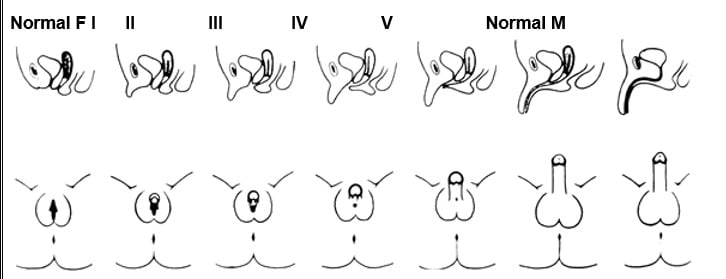
When you look at the chart, suddenly these differences don’t seem quite so irreconcilable. A penis is basically a massive clit, and lips are essentially empty ball sacks. Even the reproductive anatomy seems pretty similar. If you’ve read Come As You Are, you will be familiar with this gradient perspective as the author points out that we all have the same parts, just arranged differently.
Though very rare, there are some instances of people having both ovaries and testes. A bit of a yes/and situation. These gonads are referred to as ovotestis, a wonderful and descriptive word for gonads that contain both ovarian and testicular tissue.
Secondary sex characteristics: boobs, hips, and hair
Let’s be real. When we meet someone, we’re not doing any scientific tests to determine someone’s sex. We’re usually going off of secondary sex characteristics and social cues. Secondary sex characteristics are the details that develop at puberty like enlarged breasts and hips in females,
and Adam’s apples and facial hair in men. Everybody gets pubes.
There are tons of examples of people developing sex characteristics that cross the binary. Gynecomastia, when males develop enlarged breasts, is wildly common. Some estimates even claim that up to 70% of adolescent males experience this. It’s a condition that becomes less common with age and is highly correlated with higher BMIs.
Facial hair is another very common trait to develop across the binary. About 40% of people assigned female at birth develop facial hair, and it becomes more common the older you get. The vast majority of these cases are associated with PCOS.
BRAINS
Male and female brains have been studied for decades, but it wasn’t until a few years ago that we actually had a large-scale study that included trans people. While many questions remain unanswered, this research indicates that unmedicated trans people’s brains show patterns that mix male and female typical patterns. If we were to include nonbinary and intersex people in such research, we may see even more of a blending of traits.
Whether these results are causal or simply reflective of how one’s experience of life changes when one adopts a trans identity, it is clear that the brain variations we see across gender support a gradient model rather than a binary classification-type of system. It certainly shows that one’s neuroanatomy is not solely a consequence of having big or small gametes.
Non-binary sex variation is not new, and it is not going away
This article focused on the natural diversity of biological sex in humans, without intervention. The acceptance of biological sex diversity becomes all the more worthwhile adopting when we consider the environmental factors that influence our endocrine systems. Add to that all the people, both cis and trans, who are undergoing gender-affirming care that alters the various characteristics we tend to use to determine sex.
If we want to describe the actual sex variation that exists in humanity, a binary system doesn’t work, and may never have actually worked. Particularly in a world full of endocrine disruptors that play with our hormones.
But even if we restored lifestyles to ones that reduce stress and support good health, we know that intersex people have existed for millennia, if not longer. Modern lifestyles may increase sex variations over time, but some portion of humanity has always been outside of the binary.
To deny that is to deny the humanity of a group of people that, if they formed their own country today, they would be one of the top ten most populous countries in the world.